

The District of Saanich in collaboration with the CRD and the City of Victoria, is launching the regional CRD Building Benchmarking Program. The Program will provide tools to help building owners and managers improve energy management practices, including an annual report with comparisons of energy use in similar buildings. These tools will help owners identify ways to save energy, reduce emissions and cut costs. This benchmarking program will also help local governments track, manage and reduce energy use and carbon emissions from large buildings. This program will also help local governments track, manage and reduce energy use and carbon emissions from large buildings. This supports bylaws approved earlier this year in Saanich and Victoria (District of Saanich Bylaw No. 10147 and City of Victoria Bylaw No. 25-022).
All buildings, 10,000 square feet (929 m2) or larger are required to report their annual energy use and emissions on an annual basis. The requirement will apply to about 700 buildings in Saanich and be phased in over two years.
Timeline:
- February 2026: Reporting system launches. Assistance is available through the CRD.
- June 1, 2026: Buildings over 30,000 square feet (2,787 square metres) must report their 2025 data.
- June 1, 2027: Buildings over 10,000 square feet (929 square metres) must report their 2026 data.
-
June 1, 2028 and ongoing: Buildings over 10,000 square feet (929 square metres) must report their prior years data.
*This program does not apply to single family homes.
For more information and to get started with reporting: https://www.crd.ca/environment/climate-action/climate-programs-resources/benchmarking.
FAQ
- What is Building Benchmarking?
- What will the District do with the collected data?
- What buildings have to report?
- What information do I have to submit?
- How much work is involved in submitting this information?
- Will this information be shared publicly?
- What happens if I don't report my energy and carbon emissions data?
- Where can I find more information
1. What is Building Benchmarking?
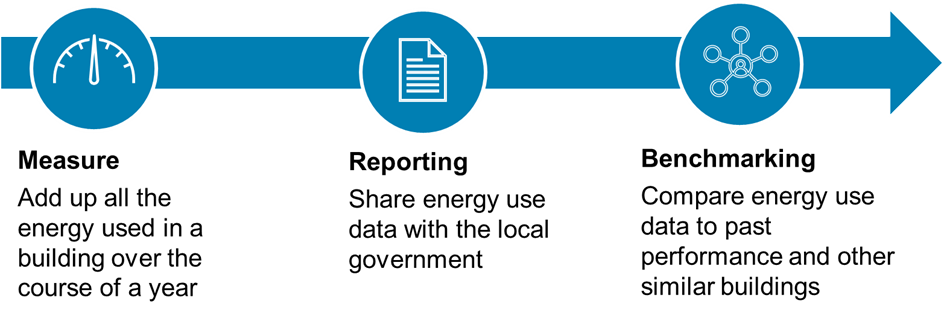
Building Benchmarking is the process of measuring and reporting a building’s energy performance over time.
2. What will the District do with the collected data?
Building owners will receive a report that includes comparisons about energy use in similar buildings and how they may be able to reduce emissions or be more energy efficient. After the first year, the program will offer a service that compares a building's energy use with other similar buildings. This will help building owners make decisions to save energy, money and reduce their emissions. The data will also be used by the District of Saanich to improve our community-wide greenhouse gas (GHG) accounting and strengthen climate-related programs and policies for existing buildings

3. What buildings have to report?
All buildings over 10,000 square feet (929 square meters).
The requirement is NOT applied to:
- Single family detached or single family attached buildings including rowhouses, townhouses, duplexes, triplexes, and houseplexes.
- Residential buildings with four or fewer residential units.
- Mixed use buildings where the primary occupancy (i.e. 50 per cent or more of gross floor area) is residential and containing four or fewer residential units.
- Buildings which have received a demolition permit.
A list of all the buildings that are subject to the requirement, and the floor area of these buildings will be made available.
4. What information do I have to submit?
Building owners must submit their annual energy use, including electricity and natural gas usage, based on utility bills, which will be used to calculate the building’s carbon emissions.
5. How much work is involved in submitting this information?
The system for reporting is mostly automated. The primary task the first year is creating a building profile in Energy Star Portfolio Manager, and then connecting utility accounts. It works similarly to social media where the user submits a request to the utility and once approved the whole building energy use data is uploaded to the software automatically. After the first year, reporting should be automated and will only require owners to check that the data is correct. Energy Star Portfolio Manager, is a free online program used by thousands of buildings in Canada to monitor energy use.
More information will be coming from the CRD about registration and reporting soon. The CRD will also help building owners sign up and upload their data.
6. Will this information be shared publicly?
Starting in 2027, data will be shared online through an interactive map and as a spreadsheet for the first cohort of buildings (over 2,878 square metres or 30,000 square feet) on the CRD’s website. Sharing this information is intended to help all building owners better understand how their building is performing compared to similar buildings so they can make changes to be more energy efficient and reduce their energy bills. Building owners can choose to opt out of sharing their energy and emissions data on the interactive map.
7. What hapens if I don't report my energy and carbon emissions data?
As this is a new program, we know it may take time to get everyone set up. We’re focusing on providing education and assistance to encourage compliance with the new reporting requirement. If a building owner will not comply with the requirement, we can issue fines under the District of Saanich Bylaw No. 10147.
8. Where can I find more information?
- You can see energy and carbon emissions reporting in practice by checking out Building Benchmark BC (BBBC), North America’s largest voluntary benchmarking program. Many buildings in Saanich have been participating in BBBC over the past 5 years.
- Saanich Council adopted the Energy and Carbon Emissions Reporting Bylaw and Schedule A on May 12, 2025.
- There are a range of programs and incentives to support energy efficiency and low-carbon retrofits in existing multi-family buildings and commercial buildings.
- More information on the background of this requirement can be found at Hello Saanich.